VersionGopher™ software by AstroSec LLC

Software version intelligence
for binaries, firmware, endpoints, and enterprise inventories.

VersionGopher™ combines lightweight downloadable collectors with a hosted analysis dashboard to discover software versions, executable metadata, CVE exposure, and software drift across diverse operating systems and architectures.

VersionGopher™ is developed and provided by AstroSec LLC, a Virginia limited liability company.

What are we inheriting? What changed? What needs attention first?
Built for teams who need a clear answer before a deal, audit, incident, deployment, or mission review.
macOS Linux x64 ARM64 ARM32 MIPS PowerPC Windows Embedded & SmallSat
Scroll to explore
Commercially useful on day one

Turn a scan into
a decision brief

VersionGopher is built for teams that need defensible software evidence before they fund a deal, approve an environment, inherit a fleet, or brief leadership on real risk.

M&A and diligence

Know what you are buying before close.

Scan acquired laptops, servers, firmware images, and offline exports to surface vulnerable software, risky archives, exposed private keys, crypto-wallet artifacts, AI prompt-risk files, unmanaged tools, and evidence gaps before integration begins.

  • Fast first-pass technical diligence
  • Evidence package for cyber insurance and board review
  • Post-close drift tracking during integration
Security leadership

Find the software your scanners miss.

Use collector output to see binaries and scripts across endpoints, servers, file shares, and air-gapped systems where EDR, SBOM, or package-manager data is incomplete.

  • CVE triage with context and false-positive controls
  • Unsigned and suspicious software review lane
  • Private-key, crypto-wallet, and AI prompt-risk discovery in scan output
Embedded and mission systems

Bring legacy and offline assets into view.

Drop small collectors onto ARM, OpenWrt/Entware ARMv7, MIPS, PowerPC, Linux, macOS, and Windows targets. Bring JSONL back to the dashboard when connectivity, custody, or mission rules allow.

  • Router, gateway, lab, and payload inventory
  • Offline collection with repeatable provenance
  • Baseline comparison for mission assurance
Start with one controlled pilot. One target set, one accountable owner, one risk brief your team can act on.
See Product Access
Product access

VersionGopher™ software and hosted analysis

VersionGopher™ is offered in two connected ways: downloadable collectors that run locally for approved users, and a hosted dashboard that turns uploaded scan output into software, vulnerability, package-risk, and drift analysis.

Downloadable software

Downloadable Collectors & CLI Software

VersionGopher™ includes downloadable collector binaries and command-line software for authorized users. The collectors are designed to run locally on supported systems and generate structured software inventory and version-discovery output for upload or offline review.

Approved users can download VersionGopher™ collectors after account approval. The downloadable software performs local file discovery, executable inspection, version extraction, metadata collection, and JSONL/JSON output generation.

SLSA Build Level 3 provenance

VersionGopher™ provides verifiable collector provenance so buyers can trace released artifacts back to the expected build workflow and source revision.

Supported collector targets

Operating systems
Windows macOS Linux
Architectures
x86_64 ARM64 ARM32 MIPS PowerPC / PPC32
Embedded and storage-frontline use

Embedded Linux targets where supported, including ARM, OpenWrt/Entware ARMv7, MIPS, and PowerPC/PPC32 systems scanning large mounted storage sets.

Storage, data lakes, and controller-frontline scans

VersionGopher collectors are designed for infrastructure beyond laptops and servers: NAS, SAN, RAID arrays, mounted forensic images, data lakes, and embedded Linux systems close to large storage estates, including OpenWrt/Entware ARMv7 and PowerPC controller-frontline targets.

Hosted service

Hosted Analysis Dashboard

VersionGopher™ also provides a hosted software analysis dashboard for importing scan results, reviewing discovered software versions, investigating CVE and package-advisory matches, comparing scans, and identifying software or environment drift over time.

Hosted dashboard workflows

Import and review

Upload or import scan output, review scan history, and filter software findings.

Vulnerability and package risk

Explore CVE matches and OSV npm/PyPI package advisory matches.

Comparison and drift

Compare software inventories and track version drift for intentional scan groups.

Scoped visibility

Review metadata across operating systems and manage organization or group-scoped scan visibility.

VersionGopher™ is developed and provided by AstroSec LLC, a Virginia limited liability company.

Recent supply-chain news

Package registries are now part of the incident scene.

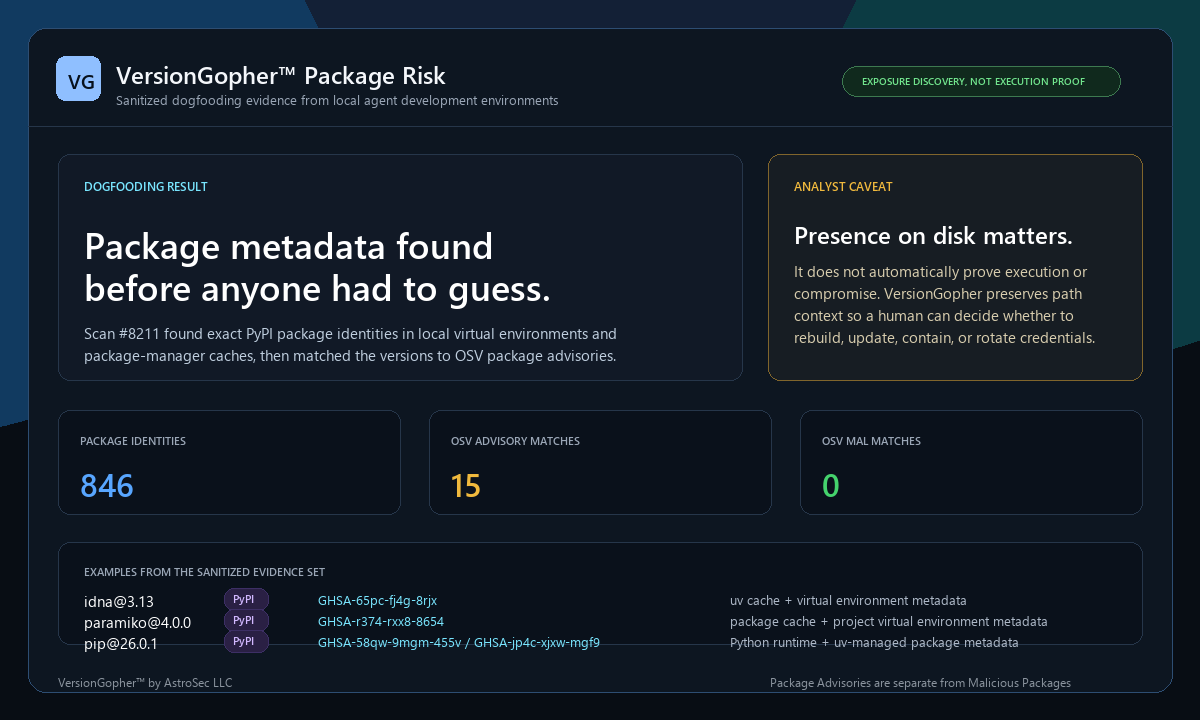
Recent npm, PyPI, Crates.io, GitHub, and developer-extension attacks all point to the same operator question: which endpoints, CI runners, caches, mounted images, and storage estates had the named package or version on disk?

VersionGopher™ package-risk scanning is built for that first exposure answer, while keeping ordinary OSV advisories separate from known malicious-package findings.

Read the package-risk note
VersionGopher package-risk evidence from a dogfooding scan Dogfooding scan evidence, sanitized for public preview.

Scan Any OS

Native collectors for macOS, Linux, Windows, ARM, OpenWrt/Entware ARMv7, MIPS, and PowerPC. Lightweight binaries traverse entire filesystems in seconds.

🔍

Extract Versions

Deep PE resources, PE Rich Header evidence, ELF notes, Mach-O plist extraction, and script regex - no version escapes detection.

Δ

Detect Drift

Compare software genomes over time to identify new executables, changed versions, removed components, leftover agents, and unauthorized software across enterprise, embedded, and satellite fleets.

🛡️

Vulnerability Matching

Automated NVD CVE matching with CPE resolution, EPSS exploitation probability, CISA KEV catalog, and GitHub PoC search.

📦

Package Risk

Identify exact npm and PyPI package evidence, then separate ordinary OSV advisories from MAL malicious-package findings.

📊

Actionable Reports

Buyer-ready assessment reports combine CVE exposure, OSV package advisory matches, sensitive-artifact indicators, binary context, and scan provenance.

🛰️ Flight-Ready

From Routers
to Orbit

VersionGopher's embedded collectors are small enough to run on ARM, OpenWrt/Entware ARMv7, MIPS, and PowerPC Linux systems, IoT gateways, routers, and small satellite flight computers. Drop the right binary on the target, scan without network access, and move compact JSONL results back to the ground station or SOC when connectivity allows.

242KB
ARM Stripped + UPX
0
Network Required
34K+
Files/Second
🔧
Embedded Linux & RTOS

Collectors target ARM32, ARM64, OpenWrt/Entware ARMv7, MIPS, and PowerPC Linux - BusyBox routers, industrial gateways, avionics, and CubeSat flight software.

MIPS
Heritage MIPS Hardware

MIPS little-endian builds cover router SoCs, payload support boards, lab testbeds, and long-lived embedded controllers where hardware outlives normal software lifecycles.

PPC
PowerPC Infrastructure Targets

PowerPC 32-bit big-endian builds cover telecom-class controllers, storage-frontline systems, mission labs, and other deterministic embedded Linux environments.

🛰️
SmallSat Firmware Audits

Inventory every binary on a satellite payload before launch. Cross-reference against NVD to verify no known-vulnerable libraries fly.

🔒
Air-Gapped Operation

Runs entirely offline. Collect JSONL on the target, transfer via serial/USB/downlink, and analyze on the ground station.

Footage: NASA/GSFC · BurstCube & SNOOPI CubeSats deployed from the ISS, SpaceX CRS-30, April 2024 · OSIRIS-REx departure from asteroid Bennu

See your entire
software estate

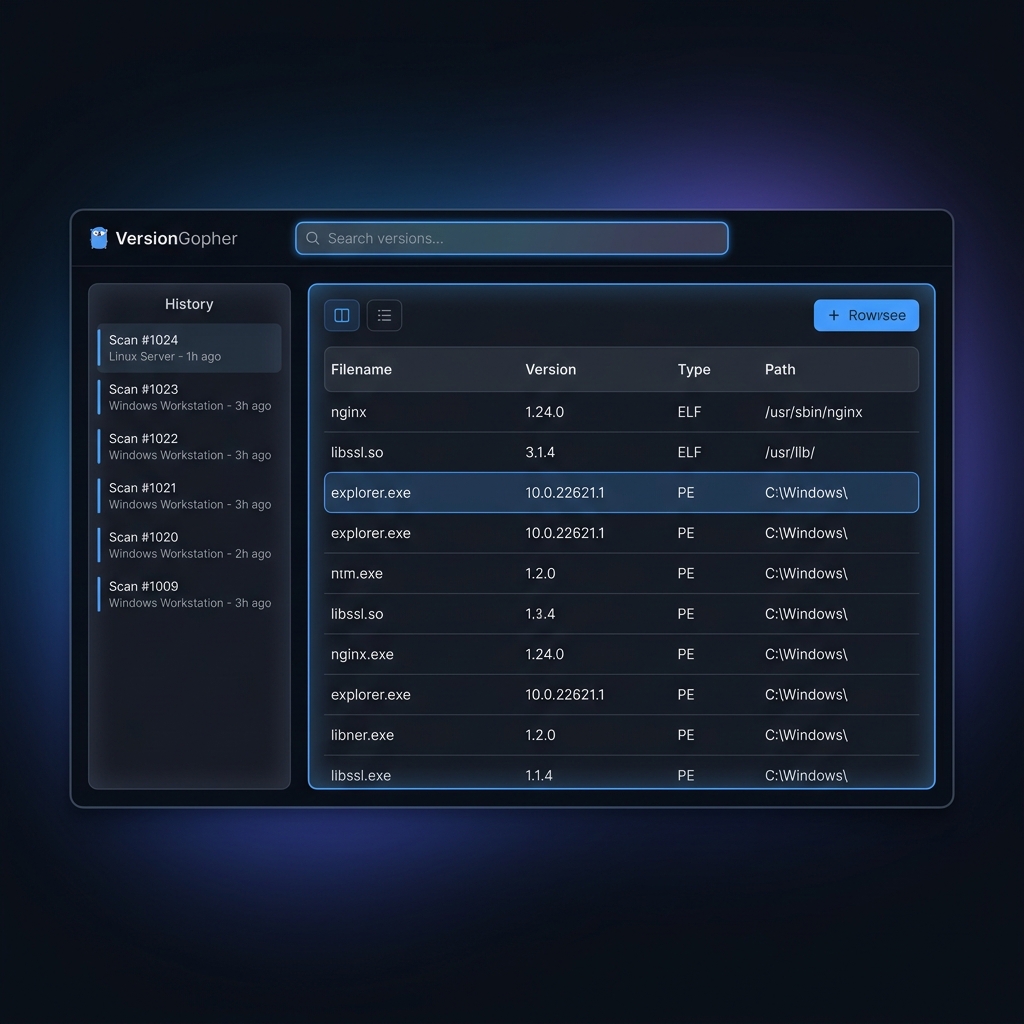
Search and filter across hundreds of thousands of binaries. Every version, every path, every file type — indexed and queryable in real time.

VersionGopher dashboard showing version search results
Software & Environment Drift Detection

Detect software drift
before it becomes risk

Operating environments rarely stay frozen after deployment. MSPs change, MSSPs rotate, endpoint agents are replaced, old tools are only partially removed, and new executables appear over time.

VersionGopher compares current scans against known-good baselines to reveal what changed across your software estate - from enterprise endpoints and servers to embedded Linux systems and pLEO satellite payloads.

Baseline Comparison

Compare any scan against a golden image, previous scan, or approved mission baseline.

Unexpected Executables

Find new binaries, scripts, payload processors, agents, or tools that were not present in the approved environment.

Version Drift

Track upgrades, downgrades, patched libraries, stale components, and silent version changes.

Agent Overlap & Cleanup Gaps

Detect leftover RMM, EDR, antivirus, VPN, monitoring, or MSSP tooling after vendor transitions.

Fleet-Level Change Tracking

See which systems drifted, when they drifted, and whether the change is isolated or spreading.

Mission Baseline Assurance

Verify onboard software still matches the approved pre-launch or post-update baseline across pLEO and SmallSat systems.

Know whether endpoint security, remote-management, VPN, monitoring, and operations agents are actually present - and whether legacy tools were fully removed.

VersionGopher does not just tell you what version is present. It tells you what changed, what appeared, and what no longer matches the approved baseline.

Binary Forensics & Provenance

When names lie,
the binary tells you why

Analysts need to know whether a CVE match is real, whether a binary belongs on a system, and how it was built. VersionGopher carries provenance into the executable card: scan source, collector hash, publisher metadata, PE Rich Header toolchain evidence, ELF build IDs, interpreter paths, dependencies, and hardening signals.

Noise-Reducing Evidence

Publisher, product, path, platform, and file-type context help separate real packages from common-name false positives.

Tamper & Hardening Cues

Flag suspicious loaders, checksum anomalies, missing ELF hardening, writable-path interpreters, and unusual dependencies.

Analyst Baseball Card

One detail view brings together CVE rationale, scan provenance, hashes, metadata, and build fingerprints for fast triage.

Executable Detail
Binary: sshd
Scan: payload-testbed-04 / MIPS embedded Linux
Collector: version_gopher 0.7.0
SHA-256: 48bbabc8495055...

ELF Forensics
  Build ID: 8d7a0c9b...
  Interpreter: /lib/ld-musl-mipsel-sf.so.1
  Needed libs: libc.so, libcrypto.so
  Hardening: NX on, RELRO partial, Canary absent

PE Rich Header
  Toolchain evidence: Visual Studio family
  Compiler/linker IDs: retained for analyst review

Result
  CVE match: explainable
  Forensic signals: 2 review, 1 hardening gap

Prioritize
real threats

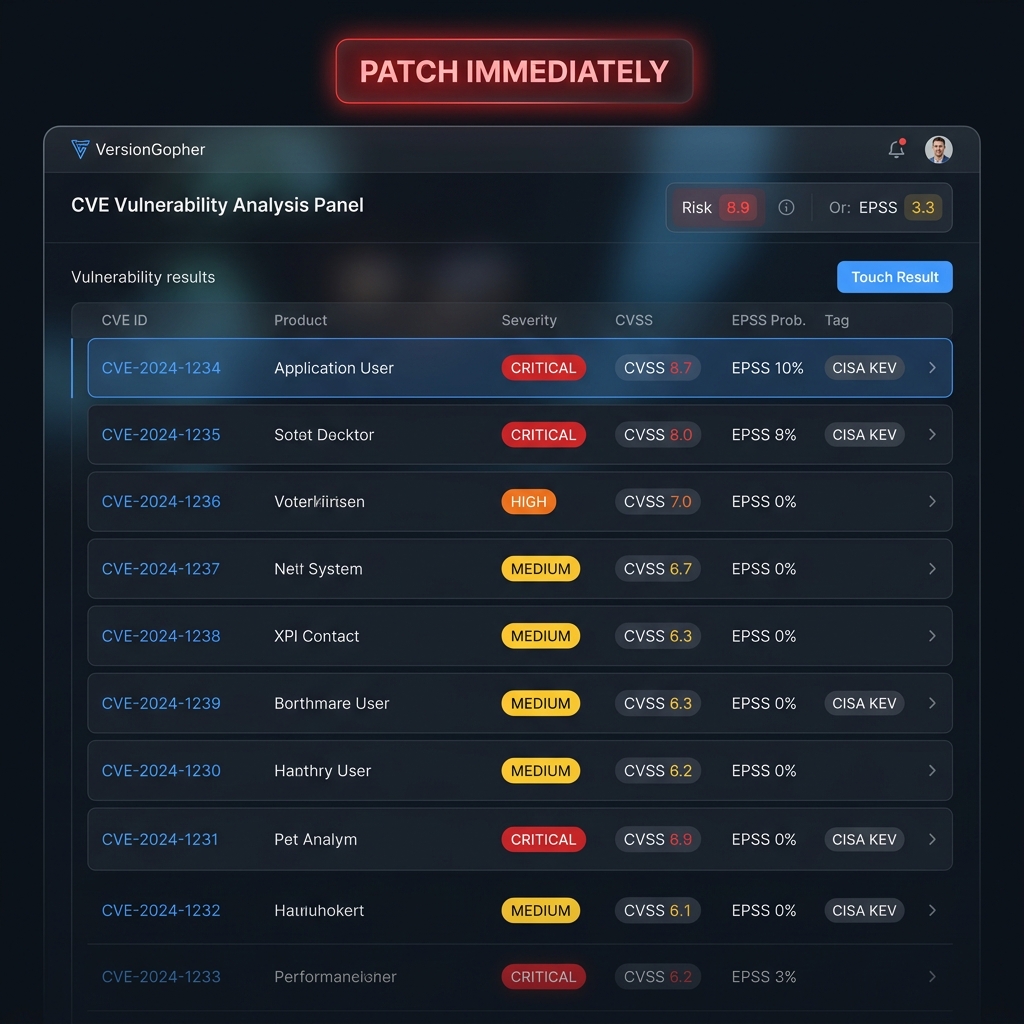
CVE results ranked by composite risk score combining CVSS severity, EPSS exploitation probability, CISA KEV status, and known PoC availability.

VersionGopher CVE vulnerability analysis panel

How VersionGopher Works

Click to explore each component of the scanning pipeline.

Cross-Platform Collectors

Lightweight native binaries compiled for every major platform. Drop a single executable on any target, run it, and get structured JSONL output ready for analysis. No agent service, no installation, no runtime framework required.

  • macOS Universal (ARM64 + x86_64)
  • Linux x64 static (glibc-free, runs on CentOS 7+)
  • Linux ARM64 / ARM32 static (routers, IoT, embedded)
  • OpenWrt / Entware ARMv7 (embedded storage and router-class Linux)
  • MIPS little-endian 24Kc (router SoCs, payload support boards, and legacy embedded Linux)
  • PowerPC 32-bit big-endian Linux (telecom-class controllers, storage-frontline systems, and mission labs)
  • Windows x64 (MSVC, Version.lib + Advapi32.lib)
Terminal
$ out="versiongopher-${HOSTNAME}-linux-x64-firmware-20260520-154233.jsonl"
$ ./version_gopher -d /firmware -J > "$out"
$ wc -l "$out"
  34,291 versiongopher-host-linux-x64-firmware-20260520-154233.jsonl

Deep Binary Analysis

The PE parser walks the full RT_VERSION resource tree, handling both type-0 (binary) and type-1 (text) VS_VERSIONINFO string entries. No arbitrary size limits on resource sections — firmware updaters with 50MB+ embedded blobs are parsed correctly.

  • PE: VS_VERSIONINFO, publisher/product strings, and Rich Header build evidence
  • ELF: .note sections, build IDs, interpreters, DT_NEEDED libraries, and hardening metadata
  • Mach-O: embedded Info.plist CFBundleVersion extraction
  • Scripts: regex patterns for version= / VERSION / __version__
  • Unicode-safe: full CJK and Cyrillic path traversal
JSONL Output
{
  "filepath": "/firmware/发生产/update.exe",
  "filename": "update",
  "version": "31.125.0.0",
  "file_type": "PE"
}

Provenance And Binary Forensics

The web pipeline preserves file-first evidence so analysts can inspect how a binary was found, what collector produced it, what metadata was present, and whether the executable shows unusual build or runtime characteristics.

  • Scan provenance: source, target, collector version, collector hash, and import path
  • PE identity: publisher, product, original filename, checksum state, and Rich Header records
  • ELF identity: build ID, interpreter, dependencies, architecture, endianness, and security posture
  • Forensic findings: suspicious loaders, missing hardening, text relocations, and static binaries
  • Analyst detail cards that explain both the CVE match and the supporting binary evidence
Analyst Evidence
filename: fusion.dll
publisher: Microsoft Corporation
path: C:\Windows\Microsoft.NET\Framework\v2.0.50727\
candidate_cpe: nagios:fusion
decision: suppress common-name false positive
reason: vendor, platform, path, and component type conflict

Automated CVE Matching

Resumable NVD sync builds a local CVE catalog. The matching engine resolves products via CPE dictionaries, applies version range logic, checks vendor and platform context, and enriches every result with exploitation intelligence.

  • NVD 2.0 API with resumable incremental sync
  • CPE product/vendor resolution from binary metadata, path context, and expert rules
  • EPSS exploitation probability scores
  • CISA Known Exploited Vulnerabilities catalog
  • GitHub PoC/exploit search with confidence scoring
  • Composite risk score: CVSS × EPSS × KEV × PoC
Risk Score
CVE-2024-3094  xz-utils  5.6.0
├─ CVSS:   10.0 (CRITICAL)
├─ EPSS:   94.7%
├─ KEV:    Yes (CISA deadline 2024-04-19)
├─ PoC:    3 confirmed exploits
└─ Risk:   PATCH IMMEDIATELY

Visual Intelligence Dashboard

A responsive web interface for exploring scan results, filtering by type and severity, and drilling into individual CVE matches. Supports multi-scan comparison, scan history management, and JSONL import from collector output.

  • Full-text search across filenames, paths, and versions
  • Severity-sorted CVE results with urgency alert banners
  • Executable baseball cards with provenance, forensic signals, and CVE rationale
  • Scan history with provenance tracking
  • JSONL import for air-gapped and hosted deployments
  • Real-time progress for large-scan CVE analysis
Quick Start
$ cd web && pip install -r requirements.txt
$ python3 -m flask run --port 5000
# Open http://localhost:5000
# Import versiongopher-*.jsonl → instant results
🏛️ Federal Compliance

Built for the
SBOM era

The 2025 CISA–NSA joint guidance "A Shared Vision of Software Bill of Materials" — endorsed by 21 international agencies — calls for organizations to generate, analyze, and integrate SBOMs into operational security workflows. VersionGopher gives you the binary-level component inventory that SBOM pipelines depend on. Read the NSA press release →

📋
Component Inventory

Discover every binary, library, and versioned component on a target — the foundational data layer for SPDX and CycloneDX SBOM generation.

🔗
Vulnerability Mapping

Automatically map discovered versions to CVEs via NVD. The joint guidance emphasizes using SBOMs for "risk-informed decision making" — not just inventory.

🌐
Supply Chain Visibility

21 international partners. One standard. VersionGopher's cross-platform scanning meets the guidance's call for interoperable, automated software transparency.

Ready to see what's running?

Start with a focused pilot: scan a laptop, server, firmware image, or inherited environment and turn the results into an evidence-backed risk brief.